About the Book
About Before We Were Free
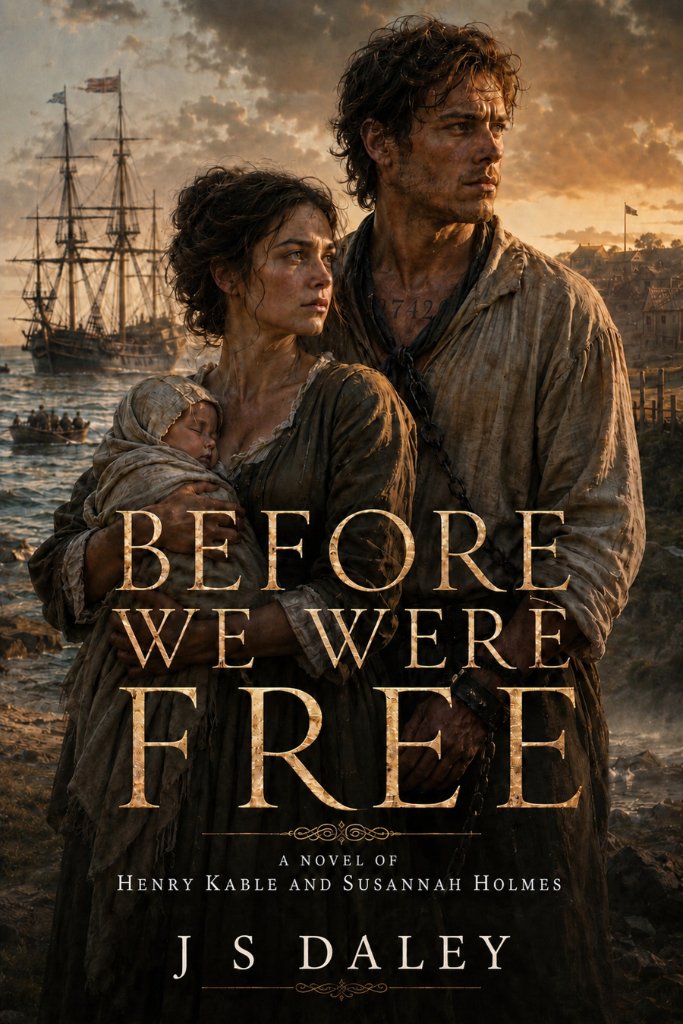
Before We Were Free: A Novel of Henry Kable and Susannah Holmes is a historical novel by J S Daley. It follows two transported convicts, their child and the family they fought to keep together through prison, transportation, the First Fleet and the first years of colonial New South Wales.
A Novel of Henry Kable and Susannah Holmes
The novel begins with people under pressure: sentences, prison walls, a child born in confinement and a family whose future could be changed by a clerk, an officer or a missing paper.
Henry Kable and Susannah Holmes are followed through transportation, Sydney Cove, marriage, loss, work, ambition and the difficult business of building a life in a new colony.
The Trial that Defined a Colony: Cable v Sinclair
Before We Were Free draws on recorded events around Thetford, Norwich Castle, the First Fleet, Sydney Cove, the missing parcel and Cable v Sinclair. The novel follows the recorded events, while dialogue and private moments are fictionalised where no exact record survives.
What is recorded and what is imagined
The novel is based on recorded events, family history and public history. Private scenes, exact words, motives and sensory details are imagined where no exact record survives, so the book should be read as historical fiction rather than nonfiction.
The First Fleet and Sydney Cove
The voyage and arrival shape the practical questions in the novel: family, food, authority, fear, opportunity and survival.
The 1788 Lawsuit: Cable v Sinclair
In July 1788, Henry and Susannah successfully sued Captain Duncan Sinclair for the loss of a parcel of clothing. The court awarded them fifteen pounds, marking the first civil lawsuit in Australian history.
Why this story matters
At the heart of the novel is a family almost divided before it reached the new colony. Henry Kable, Susannah Holmes and their child were nearly separated by paperwork, punishment and distance.
Before We Were Free follows the people behind the records, giving readers of Australian historical fiction a clear way into the story.